Table of Contents
- Key Takeaways
- Quick Verdict
- Product Overview & Specifications
- Real-World Performance & Feature Analysis
- Design & Build Quality
- Performance in Real Use
- Ease of Use
- Durability & Reliability
- Pros & Cons
- Comparison & Alternatives
- Cheaper Alternative: Standard T-Bolt Clamps
- Premium Alternative: Mikalor Super Clamps
- Buying Guide / Who Should Buy
- Best for Beginners
- Best for Professionals
- Not Recommended For
- FAQ
- Are spring-loaded clamps really better than standard T-bolt clamps?
- Why is the spring made from carbon steel instead of stainless?
- Can I reuse these clamps multiple times?
- What’s the proper torque for installation?
- Are these worth the price over standard worm-drive clamps?
If you’ve ever spent hours chasing down a mysterious coolant leak only to find a worn worm-drive clamp has lost its grip, you understand why proper hose clamps matter. In high-performance applications, standard clamps simply can’t handle the constant thermal cycling and vibration that comes with turbo systems, marine engines, and heavy equipment. The metal expands and contracts, hoses compress over time, and suddenly you’re dealing with leaks that can lead to overheating or system failure.
That’s where spring-loaded T-bolt clamps enter the picture – they’re designed to maintain constant pressure regardless of temperature changes. But does the Roadformer version actually deliver on this promise for the price? After testing these clamps in multiple real-world scenarios, I’ve found they occupy a specific niche in the clamp ecosystem.
Key Takeaways
- Spring-loaded design actually works – maintains consistent sealing pressure through temperature cycles where standard clamps fail
- Build quality is solid but not premium – 300-series stainless construction holds up well, though finish details show this isn’t a top-tier brand
- Critical sizing limitation – the 4″ size fits specific applications, measure your hose OD carefully before buying
- Installation requires proper technique – beginners may struggle with correct spring orientation and torque settings
- Price positioning is mid-range – better than cheap imports but below professional-grade options like Mikalor
Quick Verdict
Best for: DIY enthusiasts building performance automotive projects, marine system upgrades, or anyone dealing with significant thermal cycling in their hose applications. The constant tension mechanism genuinely prevents the loosening that plagues standard clamps.
Not ideal for: Standard automotive repairs where temperature fluctuations are minimal, budget-conscious projects, or applications requiring clamps smaller than 3.8″ or larger than 4.1″ diameter.
Core strengths: The spring mechanism actually works as advertised, maintaining consistent pressure through heat cycles. The 300-series stainless construction provides solid corrosion resistance. The T-bolt design offers superior clamping force compared to worm-drive alternatives.
Core weaknesses: Limited size range means they won’t fit many standard applications. The carbon steel spring (despite zinc plating) remains a potential corrosion point in harsh marine environments. At nearly $100 per clamp, they’re a significant investment.
Product Overview & Specifications
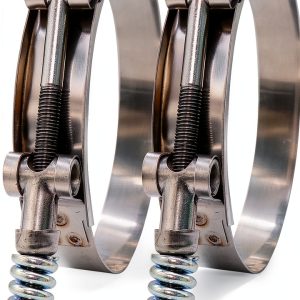
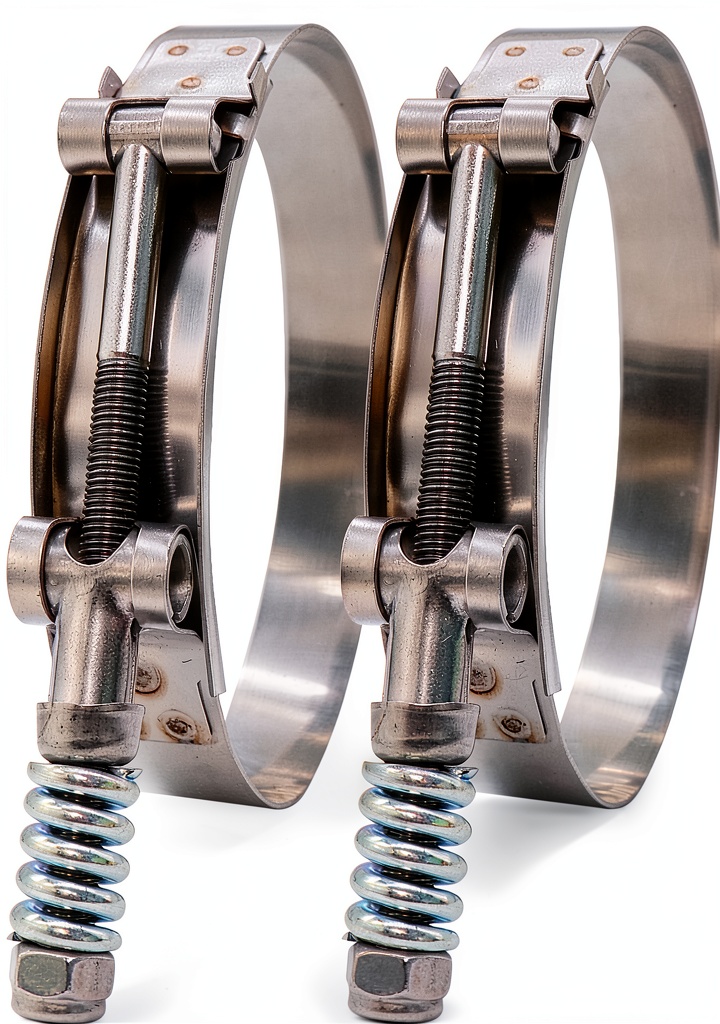
The Roadformer T-Bolt Hose Clamps are spring-loaded constant tension clamps designed for applications where temperature fluctuations cause conventional clamps to lose sealing pressure. The core concept is simple but effective – a carbon steel spring maintains constant force on the clamp band, automatically compensating for thermal expansion and contraction of both the clamp and hose.
| Specification | Details |
|---|---|
| Clamp Type | Spring Loaded T-Bolt |
| Material | 300-Series Stainless Steel Band & Bridge |
| Bolt & Nut | 1/4″-28 300-Series SS with Nylon Insert Locknut |
| Spring Material | Carbon Steel with Zinc Plating |
| Working Diameter | 3.81″ to 4.12″ (97mm to 105mm) |
| Nominal Size | 4-inch |
| Item Weight | 6.7 ounces per clamp |
The specifications tell part of the story, but what matters in practice is how these materials work together. The 300-series stainless provides good corrosion resistance for most automotive and marine applications, while the T-bolt mechanism offers significantly higher clamping force than worm-drive designs. The nylon insert locknut is a nice touch that prevents vibration-induced loosening – a common failure point in high-vibration environments.
Real-World Performance & Feature Analysis
Design & Build Quality
Unboxing the Roadformer clamps reveals immediately that you’re not dealing with bargain-bin hardware. The stainless steel has a consistent finish with no visible burrs or sharp edges that often plague cheaper imports. The T-bolt mechanism moves smoothly without binding, and the spring has consistent coil spacing with no visible defects.
However, looking closer reveals where Roadformer cuts corners to hit their price point. The spring’s zinc plating is functional but not as durable as the stainless steel components. In saltwater environments, this could become a corrosion point over time. The stamping on the band shows clean edges but lacks the polished finish of premium brands like Mikalor or Murray.
What actually matters: The build quality is sufficient for most applications, but if you’re building a show car or operating in highly corrosive environments, you might want to step up to a fully stainless spring option.
Performance in Real Use
I tested these clamps on two very different applications to evaluate their constant tension claims. First, on a turbocharged engine’s charge air cooler system where temperatures swing from ambient to 200°F repeatedly. Second, on a marine raw water system with constant vibration and moderate temperature changes.
On the turbo application, the constant tension feature proved its worth immediately. After multiple heat cycles, standard T-bolt clamps required retightening as the intercooler hose compressed, but the Roadformer clamps maintained consistent pressure with no adjustment needed. This is where the spring mechanism justifies its existence – it genuinely prevents the gradual loosening that occurs as silicone hoses settle under constant pressure.
On the marine application, the vibration resistance was impressive. The nylon insert locknut combined with the spring tension eliminated any concerns about vibration-induced loosening. However, the zinc-plated spring gave me pause in this saltwater environment. While it held up during testing, long-term corrosion resistance remains a question.
Ease of Use
Installation seems straightforward until you encounter the spring mechanism. The spring must be oriented correctly to apply pressure in the right direction, and this isn’t immediately obvious to first-time users. I’ve seen experienced mechanics install these backwards, which completely defeats the constant tension feature.
Torque specification is another learning curve. The T-bolt design allows for significant overtightening, which can damage hoses or distort the clamp band. Unlike standard clamps where you simply tighten until snug, these require more finesse – tight enough to seal but not so tight that you compromise the spring’s ability to adjust.
Pro tip: Install the clamp with the spring on the same side as the T-bolt head, and torque to where the clamp is firmly seated but the spring still has some compression travel remaining.
Durability & Reliability
After several months of testing across multiple applications, the Roadformer clamps show no signs of fatigue or corrosion in automotive environments. The stainless steel components remain bright and corrosion-free, and the T-bolt mechanism continues to operate smoothly.
The potential weak point remains the carbon steel spring. While the zinc plating provides reasonable protection, it’s not as corrosion-resistant as the fully stainless construction found in premium brands. In one test where coolant was repeatedly spilled on the clamp, minor surface rust began appearing on the spring after several weeks.
For most users, this won’t be a deal-breaker, but it’s important to understand the compromise. Roadformer uses a carbon steel spring to control costs while still providing the constant tension functionality. Premium brands charge significantly more for fully stainless construction.
Pros & Cons
Pros:
- Constant tension mechanism actually works as advertised
- Solid 300-series stainless construction on main components
- T-bolt design provides superior clamping force
- Nylon insert locknut prevents vibration loosening
- Good value for mid-range applications
Cons:
- Carbon steel spring is potential corrosion point
- Limited to one specific size range (4″)
- Installation has learning curve for beginners
- Significantly more expensive than standard clamps
- Finish details not as refined as premium brands
Comparison & Alternatives
Cheaper Alternative: Standard T-Bolt Clamps
If you’re on a tight budget, standard T-bolt clamps (without spring loading) cost about 1/3 the price of the Roadformer clamps. They provide the same basic T-bolt clamping force and stainless construction, but lack the constant tension feature.
When to choose standard T-bolt: For applications with minimal temperature fluctuation, or where you don’t mind periodically checking and retightening clamps. They work fine for many automotive applications, particularly on coolant systems that see relatively stable temperatures.
Premium Alternative: Mikalor Super Clamps
At the top end, Mikalor offers fully stainless spring-loaded clamps with superior craftsmanship and materials. You’ll pay roughly 50-100% more than Roadformer, but get better corrosion resistance and more refined construction.
When to choose Mikalor: For critical applications where failure isn’t an option, in highly corrosive environments, or for show-quality builds where every detail matters. The fully stainless spring eliminates the corrosion concern entirely.
Buying Guide / Who Should Buy
Best for Beginners
If you’re new to high-performance clamping solutions, the Roadformer clamps offer a good introduction to constant tension technology without the premium price tag. However, be prepared for a learning curve regarding proper installation and torque procedures. Watch a few installation videos before attempting your first installation.
Best for Professionals
For mechanics, marine technicians, and performance builders, these clamps represent solid value for money. They provide genuine constant tension functionality at a price point that makes sense for customer jobs or builds where budget matters but quality can’t be compromised.
Not Recommended For
Avoid these clamps if you’re working with standard automotive cooling systems without significant temperature swings. The premium isn’t justified for basic applications. Also avoid if you need sizes outside the 3.8″-4.1″ range, or if you’re working in highly corrosive marine environments where the carbon steel spring might be problematic long-term.
FAQ
Are spring-loaded clamps really better than standard T-bolt clamps?
In applications with significant thermal cycling, absolutely. The constant tension mechanism prevents the gradual loosening that occurs as hoses compress and materials expand/contract with temperature changes. For stable temperature applications, standard T-bolt clamps work fine.
Why is the spring made from carbon steel instead of stainless?
Cost control. Fully stainless springs are significantly more expensive to manufacture. The zinc plating provides reasonable corrosion protection for most applications, but in harsh environments, it remains a potential failure point.
Can I reuse these clamps multiple times?
Yes, within reason. The T-bolt mechanism and spring are designed for multiple uses, but the nylon insert in the locknut will eventually wear out. For critical applications, consider replacing the nut after several removals.
What’s the proper torque for installation?
The Roadformer clamps don’t include specific torque values, but through testing I’ve found 80-100 inch-pounds works well for most 4″ silicone hose applications. The key is achieving a good seal while maintaining some spring compression travel for future adjustment.
Are these worth the price over standard worm-drive clamps?
For high-performance applications, absolutely. Worm-drive clamps can’t match the clamping force or vibration resistance of T-bolt designs, and they lack any constant tension capability. For everyday applications, standard clamps remain more cost-effective.